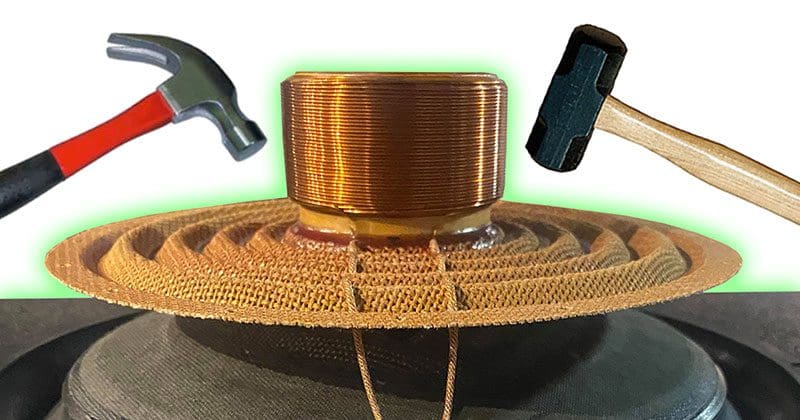
We were cruising the internet a few weeks ago and noticed a comment from a self-proclaimed car audio expert that new speakers and subwoofers need to be broken in at low power levels. He made it particularly clear that the voice coil needed to be broken in gently. If you’ve ever considered how a speaker works from more than an “it makes sound” perspective or you have a grasp of basic electrical theory, then you’ll know that these are not accurate statements.
Speaker Components and Break-In
We aren’t going to beat around the bush on this one. The only part of a new speaker that will change from its brand-new-in-box condition after several hours of playtime is the spider. Many spiders are made from cotton or Nomex that’s impregnated with a phenolic resin. When new, the spider can be somewhat stiff compared to after it’s been played for a few hours. The short and sweet of this is, once the spider has been stretched a bit, it’s good to go. An hour or two of playtime at high volume levels is usually more than adequate to make it softer and more flexible.
The important question is, does the sound change before and after? Indeed it does – a bit. A subwoofer or midbass driver might play a little lower, and the total Q of the system should drop a bit once everything is broken in. For midbass drivers, the reduction in system Q might reduce some upper-bass resonance, so frequencies under 250 Hz might seem less distorted.
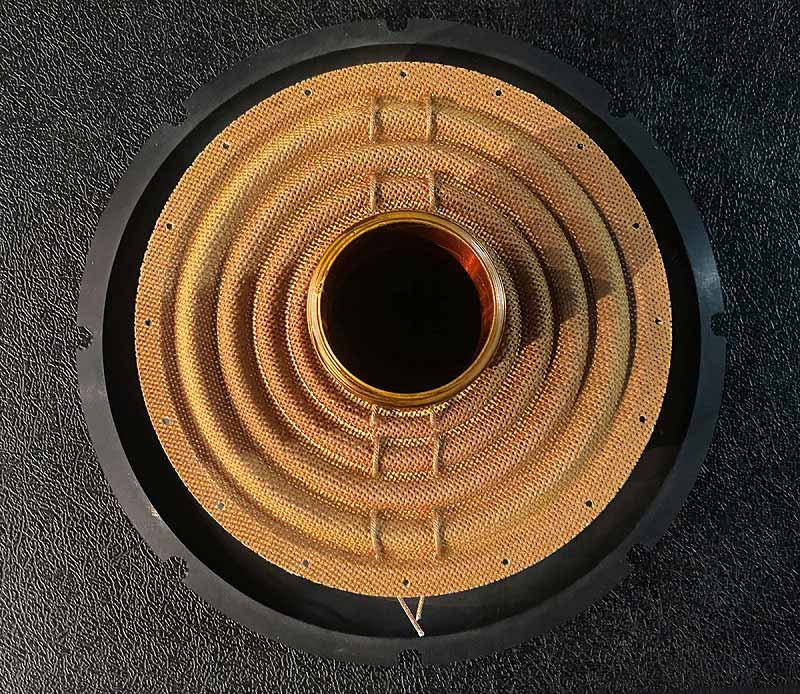
Speaker spiders impregnated with phenolic resin may need a few hours of break-in to deliver optimal low-frequency performance.
Breaking In Speaker Voice Coils
We have to apologize. We’re sitting here laughing to ourselves about the audiophile myths that speaker wire needs to be broken in or conditioned before critical listening can commence. Er, no. Wire is wire. It doesn’t rearrange its molecules when an audio signal passes unless, of course, you get the wire SO hot that it starts to glow. Sure, electrons jump between the copper (and aluminum and tin) molecules, but that doesn’t rearrange them.
The voice coil in your speakers is nothing more than a piece of wire (or maybe two) that is wrapped around a cylinder. The wire is attached to the speaker terminals with flexible conductors called tinsel leads. It’s wire. It’s just wire. Nothing more. You don’t need to condition it or break it in.
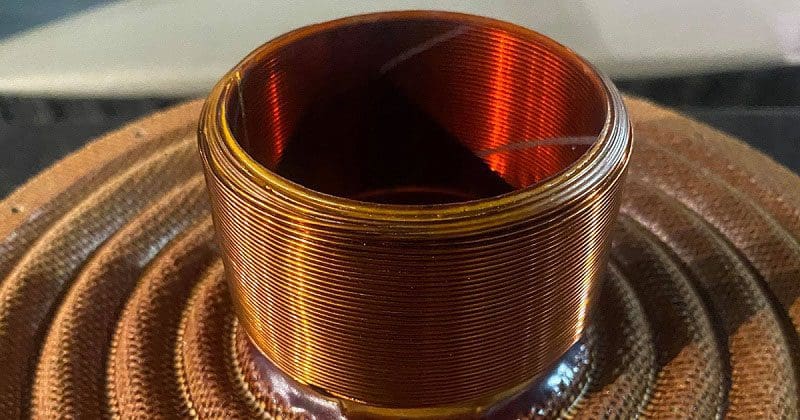
The voice coil in a speaker is simply one or two windings of wire with thin insulation. It doesn’t need to be broken in.
Comparing New and Broken-In Speakers
As we often do, let’s perform a little test. We borrowed a JL Audio 12W1v3-2 subwoofer from our friends at Burlington Radioactive. All of the subwoofers we have around here have several hours of use on them. We’ll measure the Thiele-Small parameters of the driver, then let it play for a few hours at a high excursion level to soften the suspension. We’ll measure it again once it’s cooled to see what, if anything, has changed.
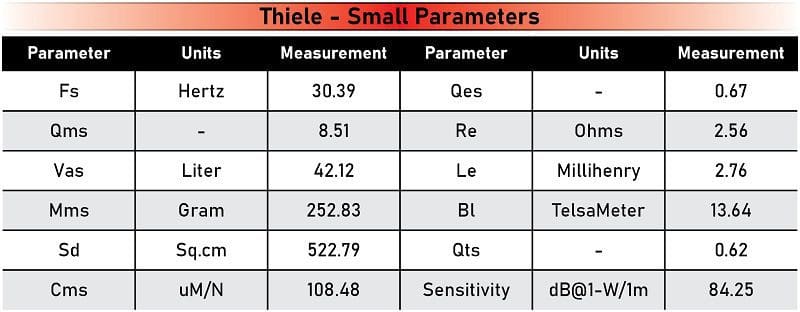
As you can see from the above specs, the Cms specification, which describes the compliance of the driver suspension, is 108.48 micrometers per Newton. All the other small-signal analysis parameters (Fs, Qes, Qms, Qts and Vas) include the Cms value in their calculations. If this parameter changes, then the rest will change. Let’s see what happens after 4 hours of exercising the woofer with a 27 Hz sine wave at 10 volts into a 2-ohm load.
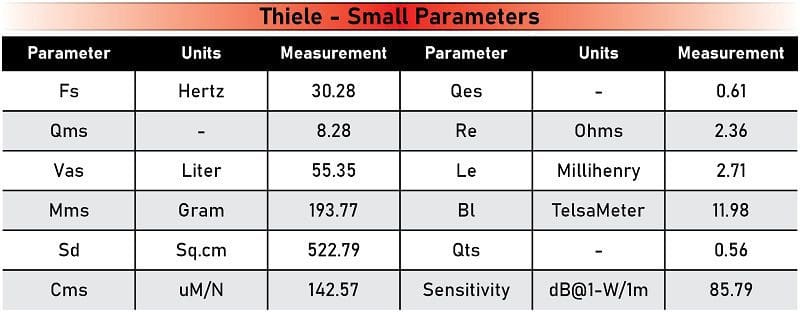
After eight hours of playing on our bench and another hour to cool off, we repeated the Small-Signal Thiele-Small parameter measurements using our Smith and Larson Woofer Test 2. The Cms compliance specification has increased to 142.57 micrometers per Newton. That’s an increase of just over 31%. Likewise, the Vas specification rose from 42.15 to 55.35 liters. This clearly indicates that the suspension is now softer, or more accurately, more compliant. However, as each driver specification works in conjunction with many other parameters, it doesn’t mean performance will change by 31%. So, let’s model the two sets of parameters in BassBox Pro.
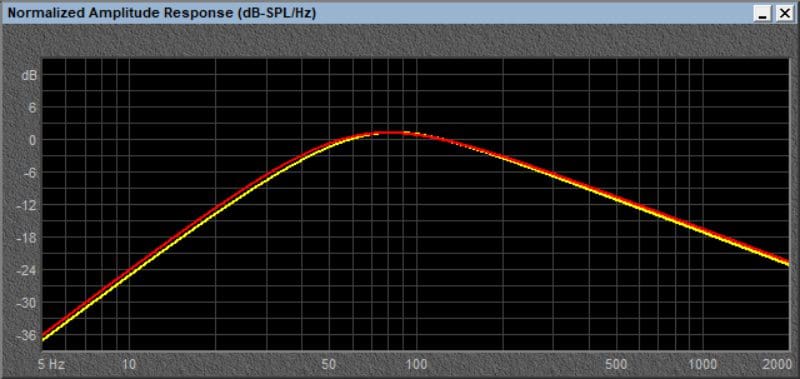
Predicted frequency Response of JL Audio 12W1v3-2 in 2.07 cubic feet. Red, before break-in; yellow, after break-in.
And voila – our hypothesis came true. On this woofer, breaking it in for eight or so hours resulted in an increase in output of just about 1 dB at 30 Hz. That’s not significant. We like that the system Q dropped from 0.707 to 0.69, but again, that’s not something to write home about. Likely, you’d never notice these changes.
The performance benefits of breaking in a subwoofer depend on the design and materials used in the suspension. This JL Audio W1v3 woofer didn’t change much, which means you are pretty much good to go as soon as you buy it. However, some speakers change more after several hours of playtime – we’ve heard it many times.
What You Need to Know About a New Audio System
If you’ve had a new audio system installed in your car or truck and there is no plan to calibrate it with an equalizer or digital signal processor, then get in the car and enjoy it. Play it as loudly as you want. Oh, and please don’t adjust the amplifier settings.
If you have a system installed that will be equalized, then there are some considerations in terms of speaker break-in. Many shops will calibrate the system with their real-time audio analyzer to match a target curve once the installation is complete. They may suggest enjoying the system for a few weeks or months, then returning to the shop so they can give it a quick tweak to address anything you might like changed. Many people like different amounts of bass or highs, so a little fine-tuning is normal. Many shops use a target response curve that includes a lot of midbass boost. Most people realize that this unnatural balance makes male voices sound exaggerated. It might be fun for listening to drums or a bass guitar, but it’s not natural. Nevertheless, a few equalizer tweaks after 20 or 30 hours of playtime is common.
Do You Need a Special Process to Break Your Car Audio Speakers In?
Do you need to break in your new speakers or subwoofers? No. You don’t. They work just fine out of the box and will handle all the power they are rated for. Actually, the stiffer spider means the woofer will move less for a given amount of power from your amplifier. If cone excursion might be an issue, it’s more likely to show up after the woofer has been exercised for a while.
Drop by your local specialty mobile enhancement retailer today to find out what speaker and subwoofer upgrades are available to make your car audio system sound amazing! And don’t fret about breaking everything in – just enjoy!
Image Credit: Thanks to Dave from Andre’s Electronic Experts in Kamloops, British Columbia, for the lead-in and voice coil images.
This article is written and produced by the team at www.BestCarAudio.com. Reproduction or use of any kind is prohibited without the express written permission of 1sixty8 media.



Leave a Reply